Friday, October 30, 2009

BG 18.71

Lord Brahma wanted to conduct one yagna. But, since Saraswati Devi was not with him, he married Gayatri Devi and conducted the yagna. After it was started, Saraswati Devi came, and found Gayatri by the side of her husband. She got angry, and cursed Brahma that he would not have any temple anywhere! That is why, only in this place, Brahma has a temple.

Brahma Temple, Pushkar, Rajasthan, IndiaBrahma Temple, Pushkar, Rajasthan, India

In Pushkaram, we have to worship Four important places. One is Pushkar lake. Second is temple of Brahma. Here, Brahma is in meditating pose. On one side of Brahma is Gayatri Devi and on the other side Savitri Devi, are gracing. There are Two temples Purana mandir and Naya mandir, in South Indian architecture and with poojas performed in Southern pattern. In Purana Mandir, Sri Venugopala, as a very large idol, is gracing, along with Consorts. On one side Sri Ranganatha, reclining, is gracing. On another side a huge idol of Swami Bhagavat Ramanuja is there. Next we see the reincarnation of Swami Ramanuja, Swami Manavala Mamunigal. All these are in Purana [Old] mandir. We can see the antiquty of the temple in its mantaps, gopurams and in prakaramas. From there we reach Naya [New] mandir. Here Sri Vaikuntanatha Swamy is gracing. There is a sannidhi for Swami Vedanta Desika, who has given us Tatparya Chandrika, commentary on Gita.

See full size image


Pushkaram is famous for Brahma, Gayatri, Savitri and the lake. The Lord resides in water and when the water was Milky Ocean, He churned it, to get Nectar or amrut for the Devas. When same water was obstructing in reaching Sri Sita, the Lord got Sethu bridge constructed. Thus the Lord is worshiped as Water and as Bridge on water! Now, we will see the summary of Chapter 17. In Chapter 16, the Lord advised to do according to Shastras. Arjuna had a doubt. What if, one did, not according to Shastras, but sincerely and earnestly? This might be the doubt in many. Is there result for such actions? It need not be great, but at least a little. In mathematics exam, students expect some marks for the steps, even if answer was wrong! Arjuna raises this doubt [17.1]. He wanted to know that what was the reward for those, who violated Shastras, but did sincerely - would they get Sattva or Rajo or Tamo result? Sri Krishna was irritated at this quaetion! He had already stressed that every action should be in accordance with Shastras. So, doing sincerely, is secondary. He then, says that such actions in accordance with Shastras, have to be done sincerely. Thus, both the conditions - in accordance with Shastras and sincerity - are important. This is what the Lord says through out the Chapter. Swami Alavandar in his Gitartha Sangraha mentions as:

a´s¯astram.¯asuram.kr. tsnam.´s¯astr¯ıyam.gun.atah.pr. thak |
laks.an.am.´s¯astra siddhasya tridh¯a saptada´soditam || (21)

Those done, violating Shastras or done without sanction of Vedas, are all with Asura quality. But those done in accordance with Shastras, will vary according to the quality [sattvam, rajas and tamas] with which they are done. Also, such Shastra accepted actions would have to be done with the Three - OM, TAT and SAT. Why we should do anything according to Shastras? Because, they are as desired by the Lord. It is like rules and regulations, in any administration. Even in a republic, people have to abide by rules and regulations. Similarly, the Lord has prescribed certain rules and regulations for the people of this Universe. That is Shastra! For those abiding by Shastras, Three types are told by the Lord in this Chapter. Those with the Three qualities, differ in worship of deities, in performance certain yagnas, do certain Dhanams, perform some Tapas, eat certain type of food. Satva persons worship Sriman Narayana and other Devas [17.4]. Rajasa persons worship Yakshas and Rakshasas. Tamasa persons worship ghosts and manes. In 17.7, He lists the food eaten by people with various qualities. Sattvika food would grow happiness and satisfaction. It would provide good health, in the long run. Too much spicy would be rajasa food. Tamasa food are spoiled and over cooked food, without natural taste and with strong smell. In 17.20, He speaks of Dhanam. Sattvika donations are done at proper time to proper person, as prescribed and donated happily. If donations are done for publicity and fame, it is Rajasa dhanam. Tamasa dhanam is done carelessly and humiliating the recipient. We will now proceed to Kurukshetra, where we will complete Gita lectures, in a fitting way!

BG 18.70

equiv="CONTENT-TYPE" content="text/html; charset=utf-8">title>

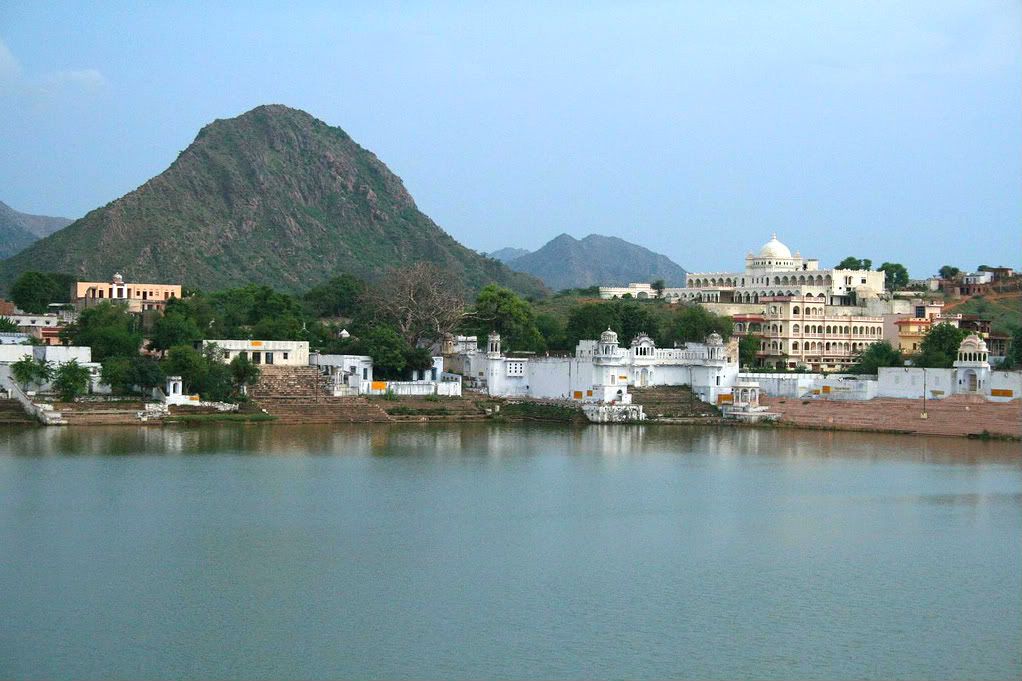
After worshiping all Dwarakas in Gujarat and Rajasthan, we have arrived at Pushkaram Kshetram in Rajasthan.

See full size image


This is one of the swayam vyakta Kshetram. Long ago, this entire place was full of water. Now only, we see houses and streets. In those days, only Pushkaram lake was existing. Here, the Lord is appearing in the form of Water. Lord Brahma wanted to do meditation in this place. That time, there was a rakshasa by name Vajranatha. He was habitual, in killing the children of this place. Realizing that only after destroying the rakshasa, he could perform meditation or yagna, lord Brahma, threw the lotus flower he held, on the rakshasa. It killed the rakshasa and the petals fell on 52 places, in about 5 miles around this place. At each of these 52 places, theerthams or sacred ponds were formed. All those 52 ponds became one lake and was called Pushkaram. Pushkaram means water fromed by lotus flower. We know that water does not stick to lotus leaf. But lotus itself becoming water, is in Pushkaram only! Later, at the request of Rishis, the Lord agreed to be present, as the water in the lake. Water and the Lord are closely connected. 'Aapo narayiti prokta: aapovai narasunara:'. Aapa – water, naara: - water, ayanam – residing place. Since the Lord is having water as His residence, He is Narayana [नारायण]. While creating, the Lord has given great importance to water. He might be seated on land or standing on hills, but He is never separated from water. It is not that the Lord is reclining only in Paarkkadal [Milky Ocean]; wherever water is there, the Lord is reclining in all those waters, be it saline ocean, or ghee ocean or even milky ocean. In all oceans, the Lord is reclining. Here also, the lake is vast and appears like an ocean. Presently, the lake is being repaired and cleaned. But once upon a time, this entire city was full of water. Presently, Pushkaram is made of Three lakes – Jyeshta Pushkaram, Madhya Pushkaram and Kanishta Pushkaram. Madhya Pushkaram is the main pushkaram, place where Sri Vishnu resides. Away, outside the town is Jyeshta Pushkaram, for lord Brahma. Each of these Pushkarams is large like an ocean! Kanishta Pushkaram is the residence of lord Shiva. There is another important incident, which we will see next day. We will also see why there is temple for lord Brahma in this place. Now, we will see summary of Chapter 16:


dev¯asura vibh¯agokti p¯urvik¯a ´s¯astrava´syat¯a
tattv¯anus.t.h¯ana vij˜n¯anasthemne s.od.a´sa ucyate || (20)

In Chapter 15, the Lord established that He was Purushottama. We have to see only Chapters 16, 17 and 18. Theses are mentioned in Chapter 16: all of us are bound by Shastras [we have to perform pooja according to Shastras; we have to follow Shastras while doing Karmas].While mentioning this, Sri Krishna tells another aspect.There are some who obey and follow Shastras. And, there are others, who do not obey Shastras. So, the Lord classifies all those who obey Shastras into one group; and those, who do not obey and violate, as another group. He calls those obeying as Devas and those not obeying as Asuras! Thus, in Chapter 16, He groups people as Devas and Asuras. Thus, this Chapter is called Devasura vibhaga adyaya. But this classification is not the theme of this Chapter. People should obey Shastras, is the main purpose. Therefore, using this classification, the Lord says that we are all bound by Shastras. We should get the Gyana about Tattvam – that the Lord is the Most Supreme God. We also need Anushtanam or practice, in accordance with that Gyana. Once we realize the Lord is the Supreme Leader, then we have to follow His orders. So, anushtanam has to be in accordance with Shastras and we can not independently do whatever we like or think. He, who does not obey Shastras and violates, is Asura. We should tell truth, not because we like to do so, but because Shastras say so. If we tell truth, just because we like it, then there could be instances, when we might not like to do what Shastras say. So it is fundamental to obey Shastras, whether we like or not. Shastras stipulate that one should observe fasting on Ekadashi. But one can not say that one would observe fasting on Sunday, being a holiday! That is, we can not choose at our will any day for fasting. If we do, we will not be obeying Shastras. Those observing fasting in accordance with Shastras are Devas. The Lord indicates the identifications of Devas and Asuras; He mentions the means of Devas and Asuras. [16.1]. Gyanam, Yagna, Tapas, Swadhyaya, etc,. are identifications of Devas. Abhayam- person called Deva is not afraid of anyone; because he is straight forward and follows Shastras. His mind should be clear. That is , he is always thinking of atman. He should be always in Gyana Yoga. Dhanam – he should donate in accordance with Shastras. We should control our sense organs. We should perform the daily Pancha Maha Yagnas. Swadhyayam – chanting Vedas regularly. Arjavam – living honestly. These are all qualities of Devas group of persons. When the Lord was to describe the qualities of Asuras, Arjuna got the fear as to in which group he belonged to! To know whether one was Deva or Asura, it is not physical outlooks like cruel face, canine teeth, horns on the head, etc. The Lord says that if Deva quality was there, it would fetch Moksham; and, Asura quality, would make the person to be reborn again and again. The Lord comforts Arjuna and asks him not to be despondent. He assured that Arjuna was certainly, a Deva. How did the Lord classify Arjuna as Deva? Simple! In all these preceding 15 Chapters, the Lord has been proclaiming about His supremacy. Had Arjuna been an Asura, he would have objected to that and stopped further lecture! Asuras will always think that whatever they had, were all earned by their efforts alone. They would claim, they were the lords, and all belonged to them. Such people with Kama, Krodha, etc., are made to be reborn again and again. The Lord asks Arjuna not to acquire any qulities of Asuras. He should go by Vedas, to know what should be followed and what should be abandoned.

Thursday, October 29, 2009

BG 18.69

We are at the entrance of Srinathji mandir in Natha Dwar[aka]. It has silver doors. As soon as doors are opened, devotees rush in for Darshan, shouting 'Jai! Srinathji!'. Inside the mantap, women are allowed to have darshan from near the Lord, and males have to be behind. All pray with fervour. There are many sevas.Every time the temple doors are opened, an alert siren is blowed and people rush to have darshan. First in the morning, is Mangala Harati, similar to Viswaroopam in South Indian temples. We now have a darshan of the Lord.


See full size image


The Lord is lifting up and holding Govardhana hill, in His left hand. The hill appears very small, within the palm. Both the hill and the arm are decorated with ornaments. Right hand is on His waist. The Lord appears with just Two hands. The idol is black and with muscles. On the idol itself, one could notice cows, peacocks, snakes, etc. The Lord was just Seven years old, when He lifted Govardhana giri. Govardhana giri is near Brindavan. As mentioned earlier, only in 18th Century, the idol was brought to this place. Next sewa is Shringar sewa or Bala bhog. Before evry sewa, the Lord is offered food items and immediately, followed by public darshan. Prasads of this temple are beyond words! Each prasad is Two palms large and one bhog prasad would be sufficient for a family of six! The Lord is decorated with dresses similar to kurta-pyjama seen in North India. Then, Raja bhog sewa. For half an hour, the Lord is offered food. Then again darshan for devotees. At about 12PM, the temple is closed. At 4:30 PM, it is Utthapan sewa. Then there is harati, when people in Thousands worship. In the evening Harati, the Lord is decorated with all ornaments. The temple is closed by about 7:30 PM, and so, sayana harati is at 6:45 PM. While the Lord is made to sleep, in summer, to remove heat, fans are used. These are not electric fans we use, but the old pankha, where air is wafted using ropes and pulleys. Two families, by tradition over centuries, are engaged in pulling the ropes through out the night. It is a great service to the Lord. Two pankhas are used - one for the Child Sri Krishna and the other for Sri Srinathji. The pankha pullers deserve our respects. Srinath means Husband of Sri or Mahalakshmi. To protect Jagat, the Lord has to be Srinath. Srinath means He is Paramatma and Purushottama. The Chapter 15 we are to see, is also called Purushottama Vidya. In 15.19, the Lord says that he, who realizes Him as Purushottama, attains Him. Swami Alavandar says that only He, Who has lotus eyes, Who is Purushottama, Who is embodiment of sattva guna, could be the Husband of Sri Mahalakshmi. Now, summary of Chapter 15:

acinmi´sr¯at vi´suddh¯acca cetan¯at purus.ottamah. |
vy¯apan¯at bharan.¯at sv¯amy¯at anyah.pa˜ncada´soditah. ||(19)

This is told in Chapter 15: Purushottama is different from, and superior to all others [which include atman or chit, is of Three categories - Baddha (like us, bonded in samsaram), Mukta (liberated from samsaram) and Nitya (ever remaining in Vaikuntam, like Adisesha, Vishvaksena), and achit (all inert matters having no Gyana). To easily remember that the Lord is different from all these Four, we can see our fingers. Thumb is different from other Four fingers; no finger can do anything, without the aid of Thumb! Similarly, the Lord is associated with all Four categories]. Let us glance at some slokas of Chapter 15. In 15.1, the Lord says that samsaram is like an inverted banyan [aswatta] tree, with roots up in Satya lok [symbolises Brahma creating from above], branches down below. This tree can be cut off only by an axe of vairagya or detachment [15.3]. In 15.15, the Lord says that He resided in everyone's heart; under His control, one understood, remembered or forgot anything. He is the One, understood from all Vedas and Vedantas. Result of Vedas are also granted only by Him. He further says that He is different from baddha and mukta atman [15.16]. He is praised as Purushottama in Vedas and in this World [15.18]. He si pervading in all, supporting all and commanding all, and so, He is different from and superior to all [15.17]. Person, recognizing Him as Prushottama, [Who has descended for our benefit as Sri Srinathji], attains Him [15.19]. We will now move to the next Kshetram.

Wednesday, October 28, 2009

BG 18.68

Two Divine names are very important. Sri Vallabha and Sri Nathan are those. The Lord is the Sweet Heart of Sri Mahalakshmi; and, He is the Husband of Her. Divine name Sri Jagannatha is well known. He is the Leader of Jagat or Universe. More Divine, is the name Sri Sri Natha. In Nathdwara, in Rajasthan, the Lord is Sri Srinathji. Today's [27th October 2009] lecture is from Nathdwara. We are at the front of the temple.

See full size image


This side of the gate is called Moti Mahal. There are Two gates, one for entrance and other for exit. Before entering, we could see the pond in this place. Actually there are Twin ponds. There is close contact between these ponds and the Lord here. We find many shops selling pictures of the Lord. Pictures of the Lord, in various decorations inside, are available. Sri Srinathaji was originally in Brindavan. The Lord appears as Sri Govardhana Giridhari. For many Thousands of years, the Lord was in Brindavan. In circa 1726, He came to this place. One Daoji, had gone to Brindavan to worship the Lord. At that time there was an invasion and there was a necessity to protect the Lord. The Lord had commanded Daoji, to carry Him Westwards. Daoji took a bullock cart and with assistance of Two persons, he carried the Lord, wrapped in husk and grass, to this place. The trip took many days. The Lord had told Daoji, that he should stop at the place, which would be indicated. When the cart came here and tried to cross the pond, it could not. Daoji realized, that place might be His desired spot. With the help of King Rana Singh, he got the Lord installed in this place and a temple was built. From that time, Millions of devotees are visiting the temple and worshiping the Lord. The Lord's sannidhi is raised on some steps. Main Deity is Sri Srinathji. Besides, as Child, Sri Navaneetha Krishna is also gracing. In this temple Swami Vallabhacharya has done many services. Poojas are performed according to Vallabhacharya tradition. Each sewa is only for a few minutes, as the Lord is Child and He might not stand posing, for long! In our tradition, temples are opened in the morning and remain so, till noon; and, again, in the evening, when the sannidhi is opened at about 5 PM, it is kept opened till 9 PM or so. Here, at 5 AM the sannidhi opens and closed by 5:30 AM. Again harati at 7:15 AM and closed by 7:45 AM! Then again, between 9:15 and 9:45 AM; 11:15 and 11:45 AM. Like this for very short durations dharshans are available. We will see the Lord in the next day's lecture!
We will now see summary of Chapter 14:

gun.abandhavidh¯a tes.¯am.kartr. tvam.tannivartanam |
gatitrayasvam¯ulatvam.caturda´sa ud¯ıryate ||(18)

In Chapter 13, Sri Krishna told Arjuna that body was different from atman, both of which were different from the Lord. Kshetram was body, to be recognized as cultivable land. This is known by Kshetragya or atman. The Lord resides in both of them. Arjuna got the doubt, as to how the body was binding atman. One takes birth because of past karma and gets a body to reside. How body controlled atman? What Sri Krishna told as reply, is mentioned in Chapter 14, says Swami Alavandar: the three qualities bind atman in samsaram; actions are due to the inducement by the three qualities [by nature atman is not to do any action]; [does it mean atman can not get liberated?] means of liberation; the Lord only, grants the Three desires [of Bhaktas - wealth, Kaivalyam and Paramapadam, to serve the Lord for ever]. These four points are told in Chapter 14. In 14.2, He says that with the Gyana, described in Chapter 13, acquired, he reaches saadharmyam [that is, whatever is His nature, like Satyam, Gyanam and Anantam, he also attains the same. That is, by reaching Vaikuntam, this person also acquires equality with the Lord in these qualities. We have to note that this person does not become one with the Lord, as told by Sri Krishna]. Jeevatma's Gyana was covered by samsaram, and it is cleared. He further explains how each of these Three - sattva, rajo and tamo - qualities bind us. Sattvam keeps us in happiness and comforts, and binds us in samsaram [14.9]. Rajo quality binds us in desires arising out of action, tamo quality puts us in delusion. Sattva quality keeps one in happiness, good health and with knowledge [ 14.6]. Rajo qualitywill keep our desires enhanced [14.7]. Tamo quality will keep us in carelessness, laziness and sleep [14.8]. He, who understands that his actions are due to influence of qualities, and atman is not responsible, attains similarity with the Lord. Soul is inside body, formed by the Three qualities; and so influenced by them. In 14.23, the Lord says that qualities would be doing their nature, and why atman should get worried about that. We should be indifferent to them. In 14.25, it is said that if we keep ourselves away from worldly activities, with this knowledge, and be indifferent to praises and abuses, then we are considered to have crossed those qualities.

Tuesday, October 27, 2009

BG 18.67

Sri Krishna was the darling of the Five lakhs females of Brindavan. From there, He came as Sri Dwarakadeesha in Dwaraka, which He got constructed. Dwaraka city was about 120 Miles in length! In that, Gomati Dwaraka was the beginning or the Drawing hall! We have now come to Bhet Dwaraka after travelling by boat, and this is the place where His palace was. This place is also called Bhent Dwaraka. Bhet means island, in Gujarati. Bhent means offering. Kuchela offered Two handfulls of puffed rice. This is the place where he offered and so it is Dwaraka [where Kuchela] offered. Sri Andal desired, that at dawn, getting up from bed, She should hear the sweet music of birds, singing the arrival of Sri Dwarakadeesha of Tirumaliruncholai! This She told from Srivilliputthur! Her Bhakti was so great that She desired the garlands worn by Sri Krishna in Dwaraka, thousand Miles away! If we also want the arrival of the Lord to our houses, then we have to acquire the knowledge indicated in Chapter 13! Chapters 13 to 18, form the Charama Shadka. We will see them one by one. In the summary of Charama Shadka, Swami Alavandar says that the Lord had told whatever was to be told to Arjuna, in the preceding 12 Chapters.
pradh¯ana purus.avyakta sarve´svara vivecanam |
karmadh¯ırbhaktirity¯adih.p¯urva´ses.o 0ntimoditah.|| (4)
Those which were left out in the preceding Chapters, are being told in the last Six Chapters. Pradhana means all associated with body or prakruti. That is, it includes ahankaram, mahan, Five Bhoota, Five Karmendriya, Five Gyanendriya, Five Tanmatras and mind [24 in total]. These are inert matters. Purusha means Jeevatman. Then Sarvesvara, the Lord, Who controls Pradhana and Purusha. Vivecanam means viveka gyana or analytical knowledge. That is understanding that body and soul are different in all respects. Also, understanding the Lord as the Owner and Commander of body and soul. All these were told in previous Chapters. Now, we will see summary of Chapter 13:

dehasvar¯upam.¯atm¯aptihetuh.¯atmavi´sodhanam |
bandhaheturviveka´sca trayoda´sa ud¯ıryate || (17)

In Chapter 13 these were told: Body is temporary, got out of past karma. Soul is not natural associate of any body [13.2]. Body is like the cultivable land and good crops of good characters, are to be grown. Atman which realizes this need, is Kshetragya. Person pervading both, Kshetra and Kshetragya, is the Lord. Once this atman gyana or realizing atman swaroopam [nature] is achieved, one can attain the Lord. To make our mind proper, certain qualities have to be built up. Twenty such qualities are listed from 13.8. Amanitvam - without attachment, adambitvam - without publicity. Talking of publicity, we can see it in Kuchela's story. Kuchela was known as Sudhama, was a classmate of Sri Krishna, under Sandheepani, in Ujjain. Sudhama was poor and had a large family to look after. His wife suggested to visit Sri Krishna, Who was a great King of Dwaraka, and bring some money for support of the family. Kuchela was reluctant to go and pray for material benefits. She argued that if Sri Krishna were to know that Sudhama was not able to support his family, it would cause Him agony. At least to avoid that he should visit Sri Krishna. Finally Sudhama agreed to go, but wanted to carry something to offer to the Lord. She gathered some puffed rice from other houses and making it into a small bundle, she gave it to her husband. When he reached Sri Krishna's large palace, Sudhama was hesitant to enter. At that time Sri Krishna saw Sudhama from balcony and arranged to receive His old friend. He offered Sudhama seat and personally comforted him! Sri Krishna's Wives were also at the service of Sudhama. After enquiring about his welfare, Sri Krishna asked whether he brought anything for Him! Feeling shy, Sudhama;s hand automatically went for the bundle. Sri Krishna immediately, grabbed the bundle and started eating the puffed rice. He praised the taste of it and took Two morsels. Instantly, in Sudhama;s place, all wealth were granted. Sri Krishna talked to Sudhama about their school days and mentioned that their teacher had blessed them both, prosperity. Sudhama felt shy to ask for any help from Sri Krishna and he, after sometime, took leave of the Lord. Kuchela felt relieved that he did not ask for anything! Not knowing what had happened at his place, Sudhama, when reached, was surprised at the transformation. Bhakti can fetch material benefits; but if we pray for material benefits, Bhakti would not grow. All such noble qualities should be acquired. In 13.20, the Lord told that because of association with the Three qualities[sattvam, rajas and tamas], atman suffers rebirths. To get released we should realize the difference between atman and body [13.24]. Now, we take leave of this place and proceed to Sri Nathji mandir in Rajasthan!

BG 18.66

We will see Chapter 12. Arjuna said that he had hopes that by acting in Bhakti marg, he would get salvation. But he also felt that Bhakti was not in our habits. Can we switch over to Bhakti so easily? Can our habits and practices that easily change? Sri Krishna replied him, that it was not like that, and there were many easier steps available for practice. This is the summary of Chapter 12. Swami Alavandar says this as:

bhakte´s´srais.t.hyam.up¯ayoktih.a´saktasy¯atmanis.t.hat¯a |
tatprak¯ar¯astvatipr¯ıtih.bhakte dv¯ada´sa ucyate ||(16)

Sri Krishna tells that those who could not practice Bhakti yoga, should remember His auspicious qualities, continuously. Besides, they have to follow some habits. In 12.13, He says that they should never show any hatred to any living being. They must be friendly with all. They should show compassion. But many do not behave like that with us. What to do then, even when we show friendship? Then, it is better to be away from such persons. On no account we should have contacts with them. Vibheeshana left Ravana, when the latter did not heed good advice. We should be in touch with noble persons only. Because, we are not that refined to be friendly with persons who hate us. Alwars and Acharyas might have been in such elevated positions. The Lord further advised that one should show same quality to both friends and enemies. We should show the same temperament to both praises and abuses heaped on us. Slokas 12.13 and 12.18 are important. We are reviewing this Chapter, in the ocean on the way to Bhet Dwaraka. It is on an island.

See full size image


On one side is Gomti Dwaraka and on the other side is Bhet Dwaraka. Earlier they were all one and called Dwaraka. Sri Krishna established a single city Dwaraka. There are many boats to transport people. In Sri Rama Avatar, we saw boats of Guha. It takes about Twenty minutes to reach Bhet Dwaraka. After reaching it, we will see what happened when Kuchela was with the Lord. Beneath this Ocean, many archaeological studies are being conducted. Both ASI and Private Agencies, have written many reports of their findings. Those interested may see them. We could know how Dwaraka was in those times; how it was submerged in ocean, etc. Now, while travelling, we will see the summary of Chapter 12. His Bhaktas should be without ego. Where ahankara is, likes and dislikes emerge. This atman has acquired countless Karma effects, and as a result, it is now residing in this body. We take efforts to get freed from this cycle of rebirths. But when we think atman is this body, it is ahankara. Atman as such has no enemies or friends; but, through the body we acquire relations like mother, father, etc. Atman has no mother or father. Its only relation is with the Lord. So, we assume all body relationships as atman's. So we think we are happy, when our relations are happy and feel sorry, when they face problems. When our head aches, atman suffers, though atman has no head or any organ. And, we complain 'my head aches'! Thus we assume all our likes and dislikes, as atman's. We are carrying unnecessary relationship and bondage. Therefore, the Lord advises that only removal of ahankara, would result in impartial outlook, and likes and dislikes will disappear. When we go on tour, we hop from one place to another. At no time, we think of any attachment with any one place. Because, we know it is transient. Our rebirths are also like this tour. But we seldom think in any one life cycle, that it is transient and we should not show any attachment! In 12.13, He says that we should be without ahankara and view happiness and sorrow equally. Though this might look formidable, by devoting more and more on the Lord, we can achieve success. This the Lord says in 12.8. We can realize this in practice. As we travel to many such Kshetrams, our outlook and short temper will change for good. If we absorb Gita properly, then our attitude will change and get refined. Arjuna again asks how we can try to think of the Lord, when we are used to think of ourselves only? Sri Krishna climbs down a step lower, and asks him to meditate on atman. Here, a hidden agenda of the Lord exists. As one thinks of one's atman only, slowly one would realize atman's true nature! One would realize atman is servant of the Lord. But Arjuna says thinking of atman is also difficult. Sri Krishna gets to a lower step and asks Arjuna to do service. That is doing one's own Karma. Doing one's own Karma continuously, would enlighten one's knowledge about atman. Thus, again thinking of atman can be started. That would result in knowing the true nature of atman and devoting oneself to the Lord. That will result in Bhakti and eventually, reaching Him. First the Lord wanted Arjuna to do Bhakti. When he expressed difficulty, He suggested thinking of Lord's auspicious qualities. When this was also found difficult, He suggested meditating on atman. Finally, when that step also was difficult, He suggested to do one's own Karma, continuously.

Monday, October 26, 2009

BG 18.65

See full size image


After bathing in Gomati river, we have come to enter the temple. There are 56 steps to climb. Above the steps, is the tall Gopuram. On the Gopuram, a flag is hoisted on 52 Yards flagstaff! It appears, Sri Krishna lived here with 56 Crores of people! They were all brought from Mathura in a single night! Since, we can not see those 56 Crore people, 56 steps are representing them! After climbing the steps, we enter. On one side there are Four tiers and on the other side, Seven tiers. What is the reason for 52 yards staff? Stars are 27, Zodiacs are 12, Planets are 9 and Four directions - all together make 52! The flag is hoisted 5 times in a day, Three times during day and Twice during night. This is done to indicate that Sri Krishna was a King. Near the Lord, is Sri Balarama's sannidhi. He is also called Sri Trivikrama. He is holding discus and conch, and mace and lotus flower. He is also decorated with Plough as weapon. On the other side Sri Madhava is gracing. Then we see Pradyumna, son of Sri Krishna, and Aniruddha, Pradyumna's son. When we go round the temple, we can worship sage Durvasa. Once Sri Rukmini had invited Durvasa for food. It is customary for the host to eat only after feeding the guest. But Sri Rukmini had drunk water and so Durvasa was angry. He cursed that She would be separated from Sri Krishna. That is the reason, there is no sannidhi for Sri Rukmini in the temple. Her temple is about 3 KMs away, on the way to Bhet Dwaraka! Seeing Sri Rukmini suffering separation, the Lord gave His beautiful idol to Her to worship. And, that is Sri Dwarakadeesha!


Opposite the Lord's sannidhi is Devaki Matha's sannidhi, and not Garuda, as seen in other temples. This is to compensate for the initial 10 years, Devaki missed Sri Krishna. This temple was established by Vajranabhi, Sri Krishna's great grand son, with Vishvakarma's assistance. The Lord is gracing with mace in His upper right hand, discus in upper left hand. He is holding conch in lower left hand and lotus in lower right hand. The Lord's Consorts and others are on His body. Many haratis are performed for the Lord, daily. Decorations change for every Harati. In the morning, pooja starts with Mangala Harati, like Viswaroopam. All come and worship this pooja, before commencing the day. Then the Lord is offered Bala Bhog, with a new decoration. Before 8 AM, we can have Swaroopa Darshan. The Lord can be seen without any decoration. Shringar Harati is at 9:15AM. At about 11:30 AM, Raja Bhog is offered. The Lord is decorated like a King. At about 4:30 PM, Utthapan and Harati are performed. Finally, in the night Sayana Harati is done. This temple has been praised by Alwars. If we climb up and go via Gopuram, we can see the idol of Yoga Maya, sister of Sri Krishna. Flag hoisting is done after pooja for Yoga Maya. She is believed to be saving the temple. Temple has survived many natural and other disasters.
We will now see the gist of Chapter 11:

ek¯ada´se sva y¯ath¯atmya s¯aks.¯atk¯ar¯avalokanam |
dattamuktam.vidipr¯aptyoh.bhaktyekop¯ayat¯a tath¯a (15)

In Chapter 11, to actually view His Natural state, He granted special eye power to Arjuna and showed that Bhakti alone was the means to understand and to reach Him. We try tu understand the Lord through books or lectures. Here, Arjuna was gifted with Divine eyes to view Him. Alwar asks people to perform Bhakti at His divine feet. In Chapter 10, the Lord described His wealth. All were under His command. Arjuna in 11.3, expresses his desire to see Him, with His wealth! Sri Krishna tells that with the ordinary eyes Arjuna possessed, it was impossible to see Him. He was beyond His eyes and intelligence. But, because Arjuna desired, He said He would bless him with Divine eyes to see Him [11.5]. Then the Lord showed His unimaginable Viswaroopam. Sanjaya was explaining Viswaroopam to Dridharashtra, in the palace [11.9]. Arjuna sees and for sometime, he was not knowing what he was seeing. The Lord appeared with many weapons, His body with sandal paste, wearing Vanamala, with Sun and Moon appearing on His body. He saw Sri Lakshmi on His body. He found lord Brahma and lord Rudra on His.body. He could see many soldiers entering His mouth, and many others coming out. He could not see the beginning nor end, and so neither middle. He found the entire Universe on His body. Seeing this frightful image, Arjuna became panicky. He was delighted to have seen the unseen; but, that gigantic image caused fear in him. So, with trembling voice he asks the image Who He was? The Lord replies in 11.32, He was Kaala [time]. He determined what should happen at what time. He came to relieve Earth of her burden. Arjuna was a mere tool [11.33]. He directs Arjuna to fight the war and get whatever fame due. He allows Arjuna to see whatever he had seen, in the past, on His body. He could also see the result of the Mahabharata war. Arjuna says in 11.45, that the Lord was Father, Mother, the God to him. There was none equal or superior to Him. He felt ashamed that he was thinking of Sri Krishna as his mere cousin! In 11.41, he repented for having called the Lord by names, out of ignorance and immaturity! In 11.46, he requests that the Lord with thousands of arms and eyes, should return to His old Self as Sr Krishna! The Lord agreed and became Sri Dwarakadeesha.