Tuesday, July 10, 2007

BG2.80

We are now in the Thiruppulingudi Kshetram. This is the domain of Lord Bhoomi Palan. In a dispute, Bhoodevi came away from Vaikuntam to this place and the Lord came here to pacify her and so the Lord is known as Bhoopalan or Bhoomipalan. The Lord here is in reclining posture and the Moolavar Icon is big. From His Navel sprouts a lotus flower with a long stem and in the flower is seated four-faced Brahma. From the entrance of the Sanctum sanctorum [Garbha Gruham] one cannot see the entire icon of the Lord and the feet are not visible. Since Sridevi and Bhoodevi are seated at the Lord’s feet, a peeping window has been arranged at the side of the prakaram [corridor] so that devotees as they come around the corridors in clockwise [prathikshanam], can have a view of the Lord’s feet. This is a unique feature in this temple. Once Swami Ramanuja visited this place and after that he wanted to visit Alwarthirunagari. The temple Archaka’s daughter was drying paddy in the street. Swami Ramanuja enquired her whether she knew where Alwarthirunagari was. She replied that it was very nearby, at a hearing distance only. Surprised Swami Ramanuja asked her was that so near? Pat came her reply. ‘Don’t you know Thiruvaimozhi? Nammalwar has said that he is at hearing distance only from this temple’. Hearing this Swami Ramanuja was awe struck at the knowledge of the girl and fainted.

[3693:
kotuvinaippataigaL vallaiyaay* amarark_ku_itar_keta, achurargatkitar_chey*
katuvinai_nanchE! ennutai_amuthE* kalivayal thiruppuLiNGkutiyaay*
vadiviNaiyillaa malarmakaL* maRRai_nilamakaL pitikkummelladiyai*
kotuvinaiyEnum pitikkanNeeorunNaaL* koovuthalvaruthal cheyyaayE.        9.2.10
 
10. Oh Lord! You are able to take Your weapons immediately for the sake of Your
BhakthAs. You are the One who kills the asurAs to protect Devas! You are the one
who is like the poison for asurAs! You are so gracefully reclining at ThiruppuLingudi
. The unmatched, peerless, most merciful Periya Piraatti and BhUmi piraatti gently
squeeze and massage Your Beautiful tender ankles and Feet. Like them, I, the
incorrigible sinner, mahA paavi too, am longing to massage/squeeze Your Lotus Feet.
Hence, Please take me at Your place to do such kaimkaraym for You. If You do not wish
to take me, please come here at least in front of me to enable me todo that.]

From such a renowned place we are to see the last sloka of 2nd Chapter.

esa brahmi sthitih partha
nainam prapya vimuhyati
sthitvasyam anta-kale ’pi
brahma-nirvanam rcchati

"this will reach bramham, oh! Partha, after which there is no bewilderment. This should be practiced at least in the final phase of life and attain the pure happiness of bramham."

Esa sthithi – this state, brahmi- will get us brahmi. At least in the antha kale-final phase of life, should remain in this state. Then it would beget very high reward. Sri Krishna says this state- which state? Here we should interpret to indicate the essence of 2nd Chapter –Karma Yoga. It was started that Arjuna should realize the eternity of atman and should uphold his dharma of protecting his people and fight. It is not just Karma yoga but asanga Karma yoga. That is unattached, without the feeling ‘I did’ or ‘mine’ and without a desire in the result. Bramhi means it would get brahmam, which can mean it would enable reaching the abode of Sriman Narayana, that is Vaikuntam. Or, it could mean it would enable to get atman sakshatkaram or atman darshan. We have already mentioned that from 2nd to 6th Chapters, Gita deals with Atman only. From 7th to 9th chapters it would deal with attaining Paramatman. So in the Chapters 2 to 6, it will not be improper if we interpret Brahman to mean atman. This way we first understand atman well before understanding God. Therefore esa sthithi- this stage of Karma yoga is capable of getting atman darshan. In the second line, yenam- whoever, prapya- attains [atman darshan], na vimuhyati- will never get confused or will never grieve. Earlier we have seen that atman darshan would banish all miseries and worries. In the third line, asyam- in this Karma yoga, anta kalepi- at least in the final years or phase of life of a person, sthithva- do Karma yoga. In the last line, nirvanam- unalloyed by miseries and so pure happiness, rcchati- reaches, brahmam-the atman darshan or Moksham. With this Sri Krishna concludes. He advises Arjuna to stay in asanga Karma yoga that would get him atman sakshatkaram. Once that state is reached, there is no room for confusion or worries. Normally, this realization should have come up in youth time. Even if the person has become old, let him not think that Karma yoga is impossibleto practice. Even in the final phase of life, Karma yoga can be practiced and attain the eternal bliss. So we have to understand from this sloka that even if we did not realize the merits of Karma yoga all these years, it is not late to start even in the final phase of life. We can involve ourselves, even at the ripe old age, in selfless service to others, society, country or world. We should dedicate such activities as service to God. Any work we do as long as it is not self-centered and without ego and it is within the accepted boundaries of shastra, can be regarded as Karma yoga. We should get that yearning for Karma yoga at least in our old age and try to reach a little of the stitha prajna state mentiond by Sri Krishna. We should try earnestly. By practicing if we are able to achieve something it would give us that happiness. Our elders have toiled to make these methods available for us and so we should try to practice them. Karma yoga is not to be performed in a secluded jungle leaving all our near and dear ones. In fact it was Arjuna who said he would go to forests and do meditation and it was Sri Krishna Who prevented him from that and asked him to practice Karma yoga in his routine work. So our daily life is our playground and in that only we have to overcome all our challenges by practicing Karma yoga. Sri Krishna is always there to help us and we need not bother about victory or defeat in our endeavors. If we view life as an ocean of distress only, we will only get mental depression. Some regard life as challenge. The difficulty here is that since it is taken as challenge, there will be always the urge to be victorious. This will develop egoism and all our works will be self-centered. But we have to regard life as an opportunity and practice Karma yoga incessantly and do good for all and this universe. This is the essence of the 2nd Chapter.

Monday, July 9, 2007

BG2.79


Our elders have been singing Pallandu for Alwars. Why do we pray that the Alwars should live long [Pallandu]? It is they who have exposed God’s qualities and His omnipresence. If only God is imagined to be of atomic in size and had not appeared before great sages and Alwars, many would have never believed in the existence of God. Many would not have made any efforts to understand God. His beautiful forms have turned many atheists to great devotees. Today if we have any interest in Him or His qualities or His actions, it is all because of Alwars hymns. Nammalwar leads all the Alwars and we are now in one more Kshetram in the Navathiruppathi. This Kshetram is known as Thiruppulingudi and here the Lord is in a reclining posture. Here He is called Sri Bhoomi Palan, which means King [administrator] of Earth. The exact Tamil translation is Sri Kasini Vendhan and so He is called. The Reclining posture is always considered a grade better than the sitting or standing postures. At His feet on either side, Sridevi and Bhoodevi are seated serving the Lord. Nammalwar prays to God that just as these two Consorts and like Lakshmana in Srimad Ramayana, He should be asked to serve the Lord. After all he is just nearby in Alwar Thirunagari. From this Kshetram we will see the 71st sloka. As mentioned earlier, 69th 70th and 71st slokas describe different stages of a gyani who had atman darshan. The 69th sloka mentions the highest stage and 70th sloka mentions one in a slightly lower level. The person mentioned in 69th sloka does not see any of the worldly matters. This is same as Vaseekara samgya. For the person in 70th sloka, the worldly matters are all felt and seen. But he is immune to them and these worldly matters inflict no changes on him. Now we have to see the 71st sloka. Here the person is at his initial stage taking efforts for atman darshan. From this level he upgrades himself to the level mentioned in 70th sloka and then further uplifts him to the level indicated in 69th sloka.

vihaya kaman yah sarvan
pumams carati nihsprhah
nirmamo nirahankarah
sa shantim adhigacchati

"A person who has given up all desires for sense gratification, who lives free from desires, who has given up all sense of proprietorship and is devoid of false ego—he alone can attain Moksham"

The person mentioned here starts his efforts. We can listen to the levels in 69th and 70th slokas but very difficult to achieve. But the 71st sloka is intended for ordinary persons like us. Yah puman- that Jeevatman or person, vihaya Kaman- discarding all sensual pleasures, nisprahah- should abandon all desires. To do this he should be nirmamao- not claiming possession or the feeling ‘my’. Also he should have the feeling of nirahankara or not imagining body as soul or atman. Such a person would lose interest in material pleasures and would attain Moksham or eternal bliss. Shantim means desire less, not involving in materialistic pleasures and brahma prapti or reaching the God. Here Sri Krishna tells what one has to do to get that peace and eternal bliss. First step is nirahankaraha. Next is nirmamaha. Next is nishprahaha. Next is vihaya Kaman and finally atman darshan. To have atman darshan, we have to follow the four steps. We have to first destroy ahankaram. Normally this is commonly used to indicate pride. We should know why this comes? When someone does not do what we want, we abuse him and start finding faults with every action of him. This happens because we think atman and body are same. Aham is self or soul and we assume it is body, it is called, ahankaram. The soul is not man or tree or an animal. The bodies of all these do not have the intellect or gyana. But Atman has intellect. Without understanding the basic difference between soul and body, we start assuming atman is body then we are said to have ahankaram. What is the advantage in differentiating atman from body? When it is exam time, we are to study all night without sleeping. But we feel ‘ I am getting sleep or I feel sleepy’. But actually, it is the body, which requires rest and sleep. Atman never gets tired and so does not need rest. If this correct perception is there during exam time then we can throw off that laziness and sleep and study. But by going the way the body requires, one would feel asleep and may not be able to study. A sprinter, when reaching the winning pole never thinks of the aching legs but thinks only of victory. At this point the sprinter looks at atman as different from body. This is a great advantage to progress. Next, we should discard the mamakaram or assuming propreitorship. In this world nothing is ours and we carry nothing when departing from this world. But once we think something as ours, then we tend to protect it. The only thing, which can be claimed as ours, is gyana or knowledge and it will be enough if we can protect that. All others, which we claim as belonging to us, are all body, related only. The minute atman does not need any clothes or decorations. So avoiding mamakaram will drive away our desire to possess. Next is nishpraha, or discarding desires on materials. As long as water is there in a well, more water would spring. But if we dry the well totally, then no water would spring. So if we discard the materials then they will also leave us. This would lead to vihaya Kaman that is driving away the desires. This will result in atman darshan.

Friday, July 6, 2007

BG2.78

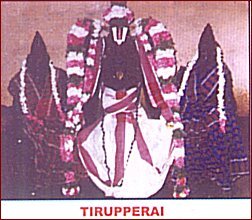
The Lotus eyed Lord of Thirupperai is blessing the devotees with Sri Sudarsana discus in the right hand and Sri Panchajanya conch in the left hand. Here we may have two questions: one, why the conch is mentioned first by Alwar and others and then only the discus is mentioned? Second, what is the connection between His lotus like eyes and the Discus and Conch? Though Sri Sudarsana has many great qualities, when it is ordered to destroy someone, it has to necessarily leave the Lord’s hand and after sometime only it returns back to His right hand. But in the case of the Conch, there is no time when it has ever left the Lord’s hand. More than that, it is the Conch, which is kissed by the Lord when He wants to blow the Conch. This privilege Discus cannot have. To answer the second question, the Lord’s eyes are like the Lotus flower. The Lotus flower blossoms when Sun rises and closes its petals when the Sun sets or when the Moon is shining. The Discus has the brilliance of innumerous Suns and so the Lotus like eyes open as a lotus flower blossoms. The Conch, on the other hand is white like a moon and so seeing that, the eyes close, as a Lotus flower would do. So, it appears the eyes of the Lord open wide and close alternately and Alwar is mesmerized by this beauty and so mentions this as he sees the Sri Sudarsana and the Panchajanya. We can also visualize this in our memory and thereby we can involve our senses in this magnificent vision and get our senses controlled. Our mind need not wander on various persons as to what harm they did or what abuses were hurled at us. By visiting temples and after return, memorizing the brilliant image of the Lord our time would be spent better. This will cultivate the satva quality in us and the mind gets disciplined. The Pandya king who ruled this place brought 108 Sri Vaishnava devotees from Thiruvellarai [in Chola kingdom] and wanted to feed them with food offered to the Lord here. When the devotees assembled, the king found only 107 persons and there was a shortage of one. The king was worried as to how to fulfill his desire. At that time the Lord appeared as a devotee and claimed that He was the 108th person and participated in the Dhadheeyaradhanai. So devotion to the Lord will enable us to have atman darshan. In the 69th sloka Sri Krishna explained how the night for ordinary people who do not have a control over their senses, is daylight for persons who have atman darshan. When ordinary people are awake, that is they are active in the worldly pleasures, it is night for atman gyani. This is the highest state for such enlightened persons. Here the person does not see those worldly matters. But in the next sloka, Sri Krishna tells of an enlightened person, who comes into contact with such worldly matters and is not influenced or affected by them. This is a lower state than the person mentioned in the last 69th sloka. Earlier we mentioned that the child devotee Prahlada was tortured by his father in many ways. Serpents were directed to bite Prahlada. But he saw the serpent as the bed of Sriman Narayana and so nothing happened to him; he was rolled down a hill and he saw Govardan, which was lifted by the Lord to protect the cowherds. He was given poison to drink and prahlada saw the blue hue of the Lord and so poison had no effect on him. He was drowned in the ocean and he saw it as the abode of the Lord and so he was saved. This devotion is a very superior state and what Sri Krishna mentions is of persons like us. The difference is that when they see a serpent or poison they do not show fear or run away but look at it indifferently. The snake or poison may kill these persons but they take it in their strides, as they are aware that body is perishable while their atman is eternal. In the earlier case the poison or snake never came in the sight of those persons; but here, though they come into contact with these they have no impact on these persons. Sri Krishna explains this with an example in the 70th sloka:

apuryamanam acala-pratishtham
samudram apah pravishanti yadvat
tadvat kama yam pravishanti sarve
sa shantim apnoti na kama-kami

"A person who is not disturbed by the incessant flow of desires—that enter like rivers into the ocean, which is ever being filled but is always still—can alone achieve Moksham, and not the man who strives to satisfy such desires."

In the ocean all river waters mingle. With that inflow, the level of the ocean does not rise. Similarly, when the rivers are dry and when there is no inflow, the level of the ocean does not fall. It remains constant -acala. Tadvat- similarly, all worldly desires and miseries even when attack, the person, who has atman darshan, he does not change and remains unaffected. Such a person attains the supreme status of shantim or Moksham. Whereas Kama yami, the ordinary persons who are after worldly matter, will never reach this position.

Thursday, July 5, 2007

BG2.77

Wearing a garland of Vakula flowers, Nammalwar has sung in praise of the Lord of Thirupperai. This place is the domain of Sri Makaranedunkuzhaikadhar. We are now below a tree bearing Vakula flowers and near the Sthala Vruksham [Temple tree] Bilva tree. There is a unique feature in this temple. Normally in all temples, the Garuda sannidhi will be exactly opposite to the Perumal sannidhi. But here the Garuda is placed slightly away. There is a story on this and Alwar also has indicated why the Garuda is not exactly in front of the main Sannidhi. Alwar imagines the Lord mounted on Garuda and is having a great procession. He imagines his mind to be the vast street in which this procession takes place. The Lord does not regard the Vaikunta or the Milky Ocean or the Solar system; but regards the minds of His devotees like Alwar as the abode of His liking. So Alwar recreates an entire festival for the Lord in his mind. He invites us near him and wants us to listen to the beats of Garuda carrying the Lord and running in procession. That is his faith and belief that the Lord is dwelling in his mind! People of this place wherever they might be would make it a point to visit this place during Garudothsavam. In this place the lord uninterruptedly listens to the sound of Vedas, festivals and the noise of children playing. From the sannidhi the Lord could not see the children playing in the streets and so requested Garuda who stood opposite to Him, to move on the side so as to get a view of the children playing. This is the reason why Garuda sannidhi is not opposite to the main sannidhi, but slightly away. If we can also like Alwar treat our mind as the abode of the Lord, then our mind will not go after the organs or worldly matters. So, whenever we think of this Kshetram, the Lord mounted on the Garuda is thought of. In the ordinary streets one may throw garbage and unwanted things. But once it is His sannidhi, we tend to maintain the sanctity and cleanliness. Similarly, if we make our mind the residence of ordinary mortals, then all sorts of things would accumulate. But if we regard it as the street for His procession, then we would maintain sanctity and keep it clear of cheap and unwanted things. We have to regard the mind as His residence and carefully maintain it. This is the most important aspect in the 2nd Chapter of Gita. From 55th sloka to 68th sloka the Lord explained the need for control of the organs. In the four slokas –55th, 56th, 57th and 58th- four samgyas or stages were mentioned. They are Vaseekara smgya, Yekendriya samgya, Vyatireka samgya and Yatamana samgya. In the 59th sloka He mentioned that by getting atman darshan, the organs get controlled. In the 60th sloka He told that by controlling organs, atman darshan would be realized. When Arjuna was confused, He told him in the 61st sloka that to control the organs, he should submit the senses in Him only. In the 62nd and 63rd slokas He made it clear how the atman, which does not think of God goes in bad surroundings and tumbles down to the bottom. In the next four slokas –64th, 65th, 66th and 67th - He explained once again how the person who devotes himself in Him, gradually rises up and how the people with wandering mind descend. In the 68th sloka He told that therefore, by devoting unto Him and by withdrawing the senses from worldly matters, one starts Gyana yoga and reach supreme status. In the following three slokas of 69th, 70th and 71st, Sri Krishna tells what all advantages accrue to that person who had atman darshan. The higher stages are explained in the three slokas in descending order, as was done in 55,56,57 and 58 slokas. In the 55th sloka Vaseekara samgya was told as the highest stage. Here in the 69th sloka He is going to tell the highest reward for the Gyani. The 56th sloka dealt with the lower level stage Yekendriya samgya. Here in 70th sloka the middle reward will be explained. In the 57th and 58th slokas the next lower stages were explained. In the 71st sloka the early rewards are mentioned. We will now see the 69th sloka carefully. Sri Krishna explains with some examples. We already witness that when it is daytime for us, it is night in North America and vice versa. Similarly, for birds like crows, visibility is there in daytime. But for nocturnal birds like owls, nighttime is visible clearly. So we can say the day of crows is night for owls and the day of owls is night for crows. Citing this Sri Krishna says that the day for a person, who has controlled the senses, is night for the undisciplined person whose mind wanders on worldly matters. That is the night for the ordinary person is day for the Atma gyani.

ya nisa sarva-bhutanam
tasyam jagarti samyami
yasyam jagrati bhutani
sa nisa pasyato muneh

"What is night for all beings is the time of awakening for the self-controlled; and the time of awakening for all beings is night for the introspective sage."

Sarva bhuthanam- all ordinary beings, that is those who have not disciplined the senses, for them [Atman darshan] is nisa- night. Here night means for those persons atman chintana or perception of atman is night. Just as we say in our conversation that if we do not understand anything, we say it is all Greek and Latin. So atman darshan is not understandable for ordinary person and so he regards it as night. Here night signifies ignorance or darkness. But samyami- those who have control over the senses, are jagrati- awake for tasyam- atman darshan. That is what is night or darkness for the ordinary persons, is bright daylight awakening for the person who has controlled his senses and so he is active. This is the first part of the sloka. In the second half, yasyam- here the ordinary persons are all awake, mune-the person who has controlled his senses, sees night. That is we are all active as in daylight in worldly matters and enjoy the inferior desires. But he, who has had atman darshan and controlled his senses, finds darkness in such worldly matters. Sri Krishna desires that we should all raise to this level of person who controls his senses. This is the highest level.

Wednesday, July 4, 2007

BG2.76


In his Thiruvaimozhi [7.3] Nammalwar praises one of the important Kshetrams in Navathirupati, Thenthirupperai. The Lord here is Sri Makaranedunkuzhikkadar, graces the devotees in a sitting posture. In front of Him is the Utsava Moorthy with four Consorts- Sridevi, Bhoodevi, Sri Thirupperai Nachiar and Sri Kuzhaikkada Nachiar. Here the Lord revealed His quality Soundaryam. It means the beauty of the lord in every limb and every organ. Nammalwar describes the immeasurable beauty in ten hymns. It is an interesting story, how this place got this name. The Lord had more love for Bhoodevi, one of His two Consorts. Though Sridevi was given a place on His chest, Sridevi felt that the Lord was more inclined to Bhoodevi. Once She revealed this to sage Durvasa. The sage agreed to resolve this and one day he went to meet Bhoodevi. She did not look at him for a couple of minutes and so Durvasa got angry. He cursed that Bhoodevi’s body also should look like Sridevi’s. Sridevi’s body was fair, while Bhoodevi had a dark green complexion. The Dark Lord was attracted by this hue of Bhoodevi. With the curse of Durvasa, Bhoodevi was afraid She will lose that skin texture and so might lose the Lord’s love. So she requested the sage to suggest a method to get Her original color restored. Durvasa advised Her to meditate in this Kshetram and solve Her problem. Bhoodevi thus arrived here and meditated. Thiru in Tamil means Sri and indicates Sridevi. Beram means body and so the name Thiruberam means the body of Sri or MahaLakshmi. Since Bhoodevi got the body of Sridevi, the name Thirupperai in Tamil means Bhoodevi, Who took the body of Sridevi. Thus the place came to be known as Thirupperai. Why this is called Then [South] Thirupperai? Since near Srirangam there is a place called Thiruppernagar, to distinguish, this Kshetram is known as Thenthirupperai. When Bhoodevi was meditating here, one day She saw two earrings appearing in the Pushkarini [temple pond]. They were shaped like a makara – s type of fish. The pushkarini got the name Matsya pushkarini. When Bhoodevi got these earrings and thinking as to whom she could adorn, the Lord appeared before Her and demanded that He deserved to be adorned with those earrings and accordingly Bhoodevi presented them to the Lord. The Lord thus got this name here. The Soundaryam or beauty of the Lord fascinated Nammalwar and so by surrendering our senses in this beauty, we could control them. We will now see the 68th sloka:

tasmad yasya maha-baho
nigrhitani sarvasah
indriyanindriyarthebhyas
tasya prajna pratisthita

"Therefore, O mighty-armed, one whose senses are restrained from their objects is certainly of steady intelligence."

Tasmad is therefore. The mind goes after the senses. With that condition we can never have atman darshan. Only by disciplining the mind we can get all advantages. By thinking about God, the mind gets controlled. So we cannot expect to control the mind on our own, but only with His help. Therefore, yasya- that atman which is trying to control the mind and organs, which are dragged by materialistic desires, can control the mind with His help only. In such an atman the intellect or buddhi gets well established and he qualifies to do gyana yoga. Here we may have a doubt. To get atman darshan we should concentrate on the atman only. Then why we are asked to devote ourselves in God? Devoting our mind on our own atman is not that superior. Also, atman does not have a form or qualities to imbibe or worship. Mind will find it very difficult to concentrate on a formless and blank entity. Whereas God has many attributes and forms and temples. This makes it easier for the mind to devote. Why so many forms for God and why so many temples and Avatars? Because our tastes differ and to satisfy every taste so many forms, temples, etc. have been arranged by our elders. God also takes so many Avatars to satisfy the varied tastes of devotees. Absorbed by the beauty of the Lord here, Alwar says that one by one all his senses were lost to Him and the mind also surrendered to him. We also by involving us in this enchanting beauty of the Lord can control the organs and mind and have atman darshan.

Tuesday, July 3, 2007

BG2.75

We are in Thirukkulandai, one of the Navathiruppati Kshetrams . The large pond here will reveal why this place has the name Perunkulam. It is just by the side of this temple. The Lord here is Sri Mayakoothan. The Lord of various Kshetrams revealed some of His qualities to Alwar. Here He exhibited the cheshtitha ascharyam character. Cheshtitham is pranks and ascharyam is astonishment. The name Sri Mayakoothan suggests the enormous and astonishing pranks of the Lord. Why should He do these pranks and what use is there for us? By involving us in His plays, or admiring His qualities or visualizing His magnificent image, our mind does not seek anything else. This interpretation is important in the present context. Our senses are all minute and at any time they can be engaged in one experience only. Our ears, for example, cannot at the same time enjoy listening to a music and also grasp the contents of a lecture. Similarly, the eyes can enjoy a dance but at the same time cannot appreciate a drama. So the organs grasp one at a time. Therefore, we can devote our senses on the Lord- the eyes must see His beautiful image, the ears must listen to His stories, tongue should sing His praise, etc. Thus all the five senses could be concentrated on Him. When this is happening, the senses will not seek other cheap things. We will now see the 67th sloka.

indriyanam hi caratam
yan mano ’nuvidhiyate
tad asya harati prajnam
vayur navam ivambhasi

"As a strong wind sweeps away a boat on the water, the wandering senses are followed by the mind; such a mind carries away a man’s intelligence."

He cites an example for the mind, which follows the sensual organs, which seek various experiences. Our organs want to enjoy sensual experiences. Eyes want to see attractive scenes. Ears want to listen to good sounds. Mouth wants to eat tasty foods, and so on. These, that is, vision, hearing, taste, scent and feeling are all matters of interest for the organs. This is what Sri Krishna tells that every organ is interested in seeking the experience, which will please. So the materials in the world attract the senses and they run after them. While doing so, they drag the mind also along with them. This is the meaning of the first part of the sloka. The matters of the world create various desires like taste, vision, etc. The organs go after them to experience those desires. Mind follows the organs. Tad, that mind, will forcibly divert the pranja, the intellect engaged in atman perception of asya, this atman that is trying to control mind. So, even though this atman had decided its mind to perceive atman, the same mind is after the organs, which are attracted by the materialistic pleasures. So there is no mind to think of atman. Mind is present but it is engaged in pursuit of other pleasures along with the organs. Mind has the capacity to think about only one at a time. But are we not thinking of so many things at the same time? Yes, then it is called a confused mind. When mind is engaged in one thought, it is clear but when it thinks many, it is confusion.So when a mind is trying to perceive atman and at that time if its attention is diverted by the organs, then there will not be this mind to think of atman. When this happens we will not have resolute knowledge. This is what Sri Krishna tells. The buddhi to understand atman is carried away by the mind and the organs. If Sri Mayakoothan abducts our mind it would be welcome, but when the senses carry away the mind disaster befalls. Sri Krishna illustrates this by n example. Just as the wind blowing opposite to the direction in which a boat is sailing will divert the boat. Here we have to regard the mind as boat, which is sailing towards atman and the winds are the organs, which divert the sailing. The method to stop this diversion is to prevent the winds blowing in the opposite direction. Since this capacity is not with us to prevent such a wind, we will have to seek asylum at the feet of Him, Who has the capacity to prevent the wind from blowing in the opposite direction. He is mightier than the wind, the Sun, the fire, the planets, this Universe and He is Sriman Narayana. By devoting ourselves to Him, our mind and senses would all get controlled. The boat also would reach its destination. Therefore, surrendering our organs in His service is the best way to control and discipline our mind and organs. Thirumangai Alwar imagining himself as a girl is being invited by her girl friends to witness the dancing Lord. This Juggler performs the dance and the girl [Alwar] is attracted. The performance was over and the performer and all spectators leave. But the girl [Alwar] remains in the auditorium. When asked by her friends as to why she is not getting up and start for home, the Alwar in his imaginary girl form says that to get up and start for home, her mind should be there. It is no longer there, as it has gone along with the Juggler. When mind is not there, no one is there to order the organs to prepare to get up. The message here is that by devoting our mind and organs in His pranks and beauty, we escape our mind and organs from engaging them in the worldly desires. Similar is the experience of Nammalwar. He says that after seeing Him, the eyes follow the Lord. We think of the mortals who are all having innumerous shortfalls. Whereas His qualities do not have any deficiency, He does not have any blemish. In every sense He cannot be faulted. So by devoting in such a perfect and blemish less Him, our organs and mind will get controlled. So when we see this great pond, we should remember Him and His astonishing pranks and thereby our mind and organs will get fixed in Him and get controlled.

Monday, July 2, 2007

BG2.74

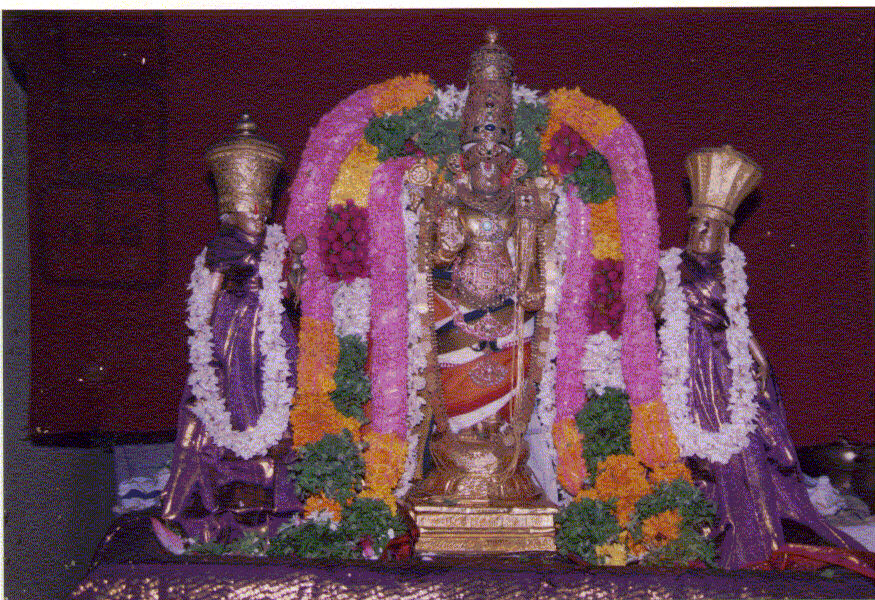
In the Alwars hierarchy, Nammalwar is fifth among the ten Alwars. Including Alwar Thirunagari, there are nine Kshetrams regarded as NavaThiruppathi. Among these is a Kshetram Thirukkulandai, popularly known as Perunkulam. But Alwar in his hymn mentions as Thirukkulandai or Thenkulam. The Lord here is Sri Mayakoothan. With Sri Kamalavathi Nachiar on His chest and with Sri Devi and Bhoo Devi on the sides, He graces the devotees. From here we are going to see the 66th sloka of 2nd Chapter of Gita. Before that let us see the history of this place. There is a big pond here and it is known as Thenkulam and Perunkulam. Long ago a sage by name Vedasara and his wife Kumudavalli, daily bathed in this pond and worshiped the Lord here praying for a child. The Lord blessed them with a female child, who was named Kamalavathi. The girl meditated and prayed that she should be His wife only. Admiring her staunch devotion, the Lord took her on His chest. Now He graces in this form to all devotees. Along with them a small idol of Garuda also could be seen. Normally, Garuda idol is placed in front of the temple. After accepting Sri Kamalavathi, sage Vedasara was devoting himself in the service of the Lord here. Once his wife Kumudavalli was abducted by a demon and hid her in the Himalayas. Vedasara prayed the Lord to restore his wife and the Lord accordingly, mouted on Garuda killed the demon and brought Kumudavalli back. He danced on the head of the demon and so He is called Sri Mayakoothan [Wonderful Dancer]. This as an unimaginable feat of the Lord. Enchanted by His beauty, Nammalwar has composed one song on this Lord. In this place there are many ponds on all directions. By devoting ourselves in Him, we can get atman darshan. This has been already told in the previous slokas. We have to always remember that in order to get our organs and mind disciplined, we have to devote ourselves in Him. Control of mind results in serene mind. Purified mind will get us atman darshan. From the 55th sloka, Sri Krishna is telling how by controlling organs one becomes a gyana yogi. The easiest way to achieve this is to worship His graceful image. If we do not do this, what all the bad consequences will engulf one, was also told. Now the 66th sloka:

nasti buddhir ayuktasya
na cayuktasya bhavana
na cabhavayatah shantir
asantasya kutah sukham

"One who is not devoted in the Supreme [in Krishna consciousness] can not have atman darshan without which a steady mind on atman is not possible, and so there is no possibility of peace. And how can there be any happiness without peace?"

He explains what all will not accrue if specific things are not done and finally, sukham i.e. Moksham will not be there. Yuktam, is surrendering our organs in Him. For the one who does not think or meditate on Him, no possibility of the intellect or buddhi for atman darshan. By devoting one’s organs, mind and intellect only, one would acquire atman darshan. Atman is so minute it is not that easy to visualize it. Impure minds can never get atman darshan. To purify mind, we have to devote our organs in Him. Ayuktam means the one who does not devote oneself in God. Such a person would never get atman darshan. What if one does not get it? If that were not there the bhavana or the thoughts on atman would not be there. That is the deep meditation will not be possible. This is told in the second line. A proper understanding of atman will only result in meditating on atman. Then we will waste all our time only in the routine things, which we are thinking all the time. Alwar asks how are we spending our 24 hours at our disposal. We reply, we have innumerous things to plan and think and enjoy, but we are wondering what Alwar is doing? Alwar all the time is seeing the same Lord and nothing else. So we think the Alwar does not have variety. Because of this they do not see the normal things, which we see. Day in and day out they are seeing the same images and the same festivals. Whereas we see so many places, eat variety of foods and listen to variety of music, drama, etc. It therefore appears that we have much more things to see and enjoy while Alwars do not have this advantage. But actually, even though they see only one Object, It s the one which is enabling us to see so many. So, if we also could ‘see’ Him, then there will not be any necessity to see anything else. So meditation on Him and atman is very much necessary. A person without atman darshan can never meditate on atman. In the third line, He explains what will happen to one who does not meditate. Here the word shanti is mentioned. Normally this means peace. But can peace bring shanthi? If we go to an isolated place where the surroundings are all peaceful, can our mind be peaceful? But a yogi, even amidst the noises in our towns would be peaceful in his meditation. So surroundings do not contribute to shanti. We are seeing that some persons sleep only if some noise is there. Absence of such sound may make them sleepless. Actually, if we see the correct interpretation of shanti it is desireless. A contented life with satisfaction with what one possesses, one may have shanti. This shanti would be there only if we could think of atman. This is told in the 3rd line. Desire less will result in shanti. Happiness accumulates with desires being lesser and lesser. This happiness will be lost as desires increase. Persons earning small wages with honest labor are able to sleep peacefully. But persons earning in crores daily, do not have this happiness. In the last line Sri Krishna tells, that lack of desire less will not get one sukham, which means here Moksham. In this sloka four stages of Ashtanga yoga are mentioned. We have heard of Patanjali’s Yoga Shastra. This is called, Ashtanga yoga and has eight stages. They are: 1. Yamam. 2. Niyamam. 3.Asanam. 4.Pranayamam. 5.Pratyaharam. 6.Dyanam. 7.Dharanai. and 8.Samadhi. Yamam and Niyamam mean the controlling of organs and mind. Asanam is sitting in the proper posture. Pranayamam is breathing properly using one nostril for inhaling and the other for exhaling. Prathyaharam is diverting the mind from all other matters and concentrating on the atman. Dyanam is deep meditation of atman. Dharanai is desire less in all others and remain detached. Samadhi is meditating on God. This is Ashtanga yoga. Out of these the latter four – Pratyaharam, Dyanam, Dharanai and Samadhi are mentioned d in the 66th sloka. First line says that devoting in God one could have atman darshan and this is Pratyaharam. In the next line He said that atman darshan will enable meditating on atman and this is Dyanam. Thinking and meditating on atman would enable one to get rid off desires in other things and that is Dharanai. In the last line He said, one could get Moksham and that is Samadhi. On our own we are unable to control organs. Why do we visit temples often? By having such darshan, our papas are dissipated, rajo/tamo gunas get diminished, likes and dislikes are removed, organs and mind get controlled. This would make us desire less and we get shanti. We therefore worship Sri Mayakoothan and get shanti.


Moolavar
Venkatavanan
Posture Standing
Star Thiruvonam
Planet Saturn
Uthsavar Mayakoothan
Thayar
Kulandaivalli
Kamalavalli
Vimanam Anandanilayam
Prathatchyam

Brahaspathi
Vedasaran
Theertham

Perungulam
Thambiravaruni
Ahamam Vaiganasam