Sarvadharman paridyacha mam ekam charanam vrajaAhamtva sarva papebyo mokshayishyami masucha.
This is the
charama sloka Sri Krishna told in
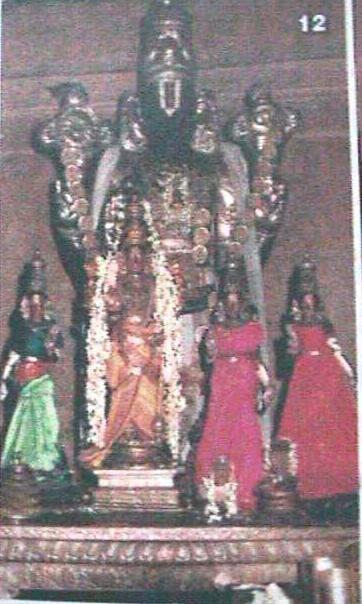
Bhagavad Gita. 'Surrender unto Me only and I will release you from all sins. Not to worry', so He told. Same Sri Krishna is appearing here as Sri Gajendra Varadan. Today's [6th March 2008] lecture is from the
vimanam [canopy] of the temple. It is on a height and one can view the natural surroundings from here. We can experience strong wind force. This
vimanam is called
Gaganahruti vimana, as it is tall and reaches sky [
gaganam]. From here we are to see the answer for an important question.
Moksham is
Vaikunta prapti; and once this supreme place is attained, no more return to this earth and no more to suffer in the cycle of births and deaths. There we will be in boundless joy in the Company of the Lord and His devotees, and serving Him. What is the way to reach that place?
Upanishad says '
tamaevam vidwan amrutha iha bhavati'. We have to see this in steps.
*
Upanishads say that knowledge - about God - is the way to reach
Moksham. This knowledge is called
vedanam or
gyana. 'Gyanan moksha:' is very clear. Can mere knowledge get us
Moksham? Will a mere knowledge ofa matter, get us that? We try to understand
Brahmam -Sriman Narayana or Sri Krishna. Will this knowledge be sufficient to reach Vaikuntam?
*Another saying is there in
Upanishad -'
atmanameva loka upaseetha'. Meditate. After knowledge, next step is
upasana or meditation. Knowledge blossoms to
upasana. It is like we gather knowledge about a matter and ponder over it.
*
Upanishads say
'
ahara suddhau tatva suddhi: tatva suddhau dhruva smrithi: smrithi lambe sarva granthinam vipra moksha:'Smrithi lambe - our thoughts are prolonged. For a long time without interruption we contemplate. This
smrithi is the third stage.
*
Sakshatkaram - continuous meditation about a matter will make us to see. Even though physically that matter may not be present, such meditation will enable us to view it even if we close our eyes. This is called '
darshana samanaakara sakshatkaram'.
Therefore, mere
gyana will not get us
Moksham. Only by meditation and
smrithi, in other words
Bhakti with
gyana, will fetch us
Moksham.
Gyana matures to
Bhakti. Some might say
Bhakti is lower level and
Gyana is the higher level and only by
Gyana yoga we can reach
Moksham. But this is not in line with
shastras.
Vedas nowhere mention such route. Even if it is agreed for an argument, surely it is not feasible to practice. Even great saints of the past have reached
Moksham only by
Gyana matured into
Bhakti. Our meditation on the Lord should be like an oil-flow, without any break- '
Thailadara avicchinna smrithi'.
Bhakti is
sneha poorvam anudhyanam. Meditation is
Bhakti; but it has to have love and affection. Thought dipped in love is
Bhakti. Mere
Gyana will be devoid of love. That can never fetch
Moksham. Gyana is surely needed, but it has to transform into
Bhakti. We have to interpret the words of
Vedas accordingly. We have to practice
yoga as was explained in Chapter 6; though, meditating on
atman was mentioned. But now on, the Lord is going to tell about meditating on Him. This is comparatively easier. We have to deviate from a dry
atman to a 'wet'
Paramatma. We have to clearly understand that a
Gyani becomes
Bhakta. Bhakti is the path for
Moksham. To have
Bhakti, we have to practice our
karma. We should remember these three steps - to reach the Lord we need to have
Bhakti; and to have
Bhakti, we should practice
Karma yoga. We have completed the first
shadgam - six [Chapters]. We are to enter the second
shadgam. We should have no more doubts on
Karma yoga. Swami Alavandar has summarised the essence of the second
shadgam - that is Chapters 7 to 12 - in his
Gitartha sangraham:
madhyame bhagavattattvay¯ath¯atmy¯av¯aptisiddhaye� j˜n¯anakarm¯abhinirvartyo bhaktiyogah prak¯ırtitah. (3).
In the middle six Chapters
Bhakti yoga is well explained. With
Gyana and
Karma as ancillaries, understanding the Lord as the Supreme and developing
Bhakti, Bhakti yoga is practiced.
The greatness of Chapter 6 is told to Parvati by lord Shiva. On the banks of
Godavari river, King Dyanasruti was ruling. He was highly learned and a scholar. Once as he was resting on the terrace of his palace, he heard the conversation between two swans flying over. Actually, the two saints wanted to guide the King to have
Brahma gyana or knowledge about
Paramatma. So, by their
yoga power, they took the forms of swan and flew over the palace. The King was familiar with birds' language. One swan told the other that below them Dyanasruti was there and so avoid flying near him as his scholarly power could burn the feathers. In reply the second swan wondered whether the King was greater than Raikva. The swans flew away; but the King was perturbed and wanted to know about Raikva and learn more from him. So he set forth a search for Raikva all over and visited places of learning like Kasi, Gaya and Dwaraka; but could not find. Finally, he came to Kashmir and searched. With difficulty he found Raikva. King was perplexed to see such a great
Gyani, sitting behind a cart wheel, full of rags and his body was full of blisters and presented an ugly picture. He asked whether he was Raikva. Raikva replied whether the King was sent by swans. Surprised, the King realized at once the greatness of Raikva and offered costly robes and jewels, for learning from Raikva. Raikva simply pushed aside all those valuables and told that he did not need them. When the King said that since Raikva appeared to be in poverty, he offered them, Raikva replied that he knew Chapter 6 and that was enough. The King then realized Raikva's knowledge and learnt a lot of things and bettered his knowledge. Such is the greatness of
Gita's Chapter 6.
We have crossed a small part of this great ocean of knowledge and a proper and correct understanding of
atman will enable us to face life and take things in their stride. We have to move forward and serve the society. We should not be carried away by the earthly pleasures and sorrows; we should lead a honest life. Our this knowledge of
Gita should make us better and move on to the next.